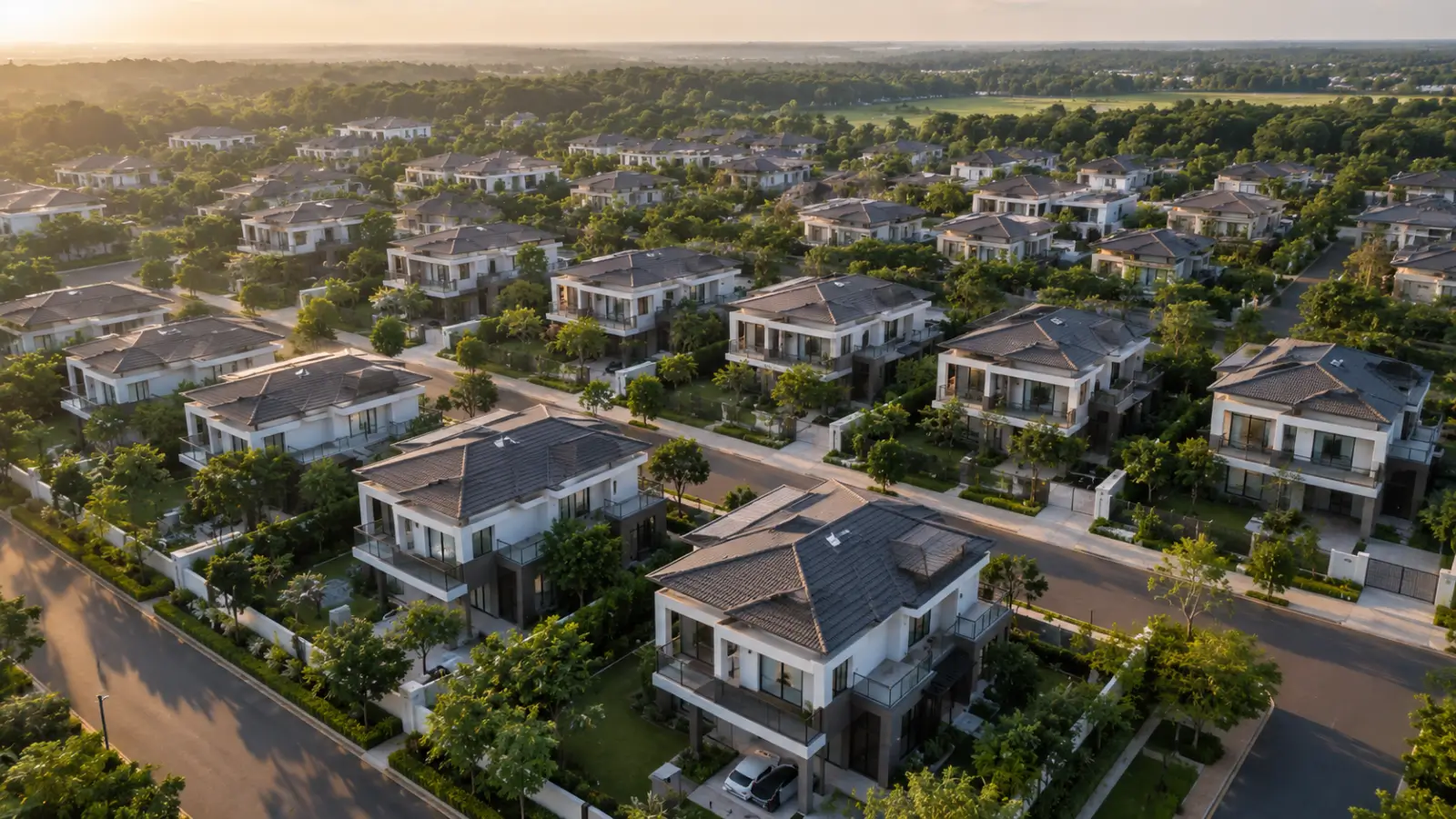
Why MAIA Mansion has 65 to 70 homes on 25 acres reduces to one founding decision: deliberate under-building. Every other characteristic follows from it....
Why MAIA Mansion has 65 to 70 homes on 25 acres reduces to one founding decision: deliberate under-building. Every other characteristic follows from it. Twenty-five acres would comfortably carry two or three hundred units at prevailing North Bangalore densities. Here the same ground holds 65–70 residences, which works out at fewer than 3 units per acre — among the lowest figures any luxury launch in the belt has recorded this cycle.
What that ratio buys is not abstract. Plot sizes begin at 8,000 sft, where much of the surrounding villa market finishes; typical stock across this belt trades between 2,200 and 5,500 sft of built-up area on materially smaller parcels. Setbacks become structural rather than aspirational, because there is room for them. Sightlines between houses stay long. A meaningful share of the parcel remains landscape rather than becoming saleable plot area, and the central green spine runs through the middle of the enclave instead of skirting its edges.
Layout decisions reinforce the density rather than working against it. Roads, greens and amenity zones follow the natural contours of the site instead of levelling them, which keeps mature tree cover standing. Recreation is grouped into its own zone so activity noise stays clear of the quieter plot clusters. Housekeeping, deliveries and staff move on a separate service network entered through a dedicated staff gate, so service traffic never crosses resident traffic. Reading the how the 25 acres are zoned shows how the four working zones separate.
Scarcity is the commercial consequence. Assembling 25 contiguous acres inside a mature micro-market and then developing fewer than seventy houses on it is difficult to repeat, which is why genuine mansion-format inventory on 8,000 sft-plus plots stays structurally rare in this belt. Land parcels of this size, this close to established institutional anchors — roughly a kilometre from the Padukone-Dravid Centre and about 1.5 km from Stonehill International School — do not reassemble easily.
One number does not move: the count. Sixty-five to seventy residences is the total, and it does not get revised upward later once demand appears. That constraint is what buyers are actually paying a premium for, and it is worth testing on site rather than on paper — the gaps between houses read very differently in person than they do in a site plan.
Related reading: MAIA Mansion Plot Sizes Compared: 8,000 vs 10,000 vs 12,000 sft.
FAQs
How many homes are planned at MAIA Mansion?
Between 65 and 70 residences across approximately 25 acres, giving a density of fewer than 3 units per acre.What does low density actually deliver?
Wide setbacks, long sightlines between houses, and a large share of the parcel retained as landscape rather than converted into saleable plot area.Could the unit count increase later?
No. The 65–70 count is the total planned inventory and does not get revised upward.
Related Articles
Infrastructure Spending in Bangalore and What It Does to Property
Transport investment reprices land more reliably than almost any other public spending, which is why Bangalore infrastructure spending real estate...

Stamp Duty and GST on Property in Karnataka: A Buyer's Guide
Two statutory charges apply to almost every property purchase in the state, and at ultra-luxury ticket sizes they stop being administrative details. Stamp...

How RERA Changed Home Buying in Karnataka
Before registration became mandatory, a buyer's main protection was the developer's reputation. Understanding how RERA changed home buying Karnataka...
North Bangalore's Growth Corridor: Airport, SEZs and Industry
Corridors form where transport, employment and land availability overlap, and North Bangalore growth corridor development has had all three for the better...